Property from the collection of Eva and Konrad Seitz
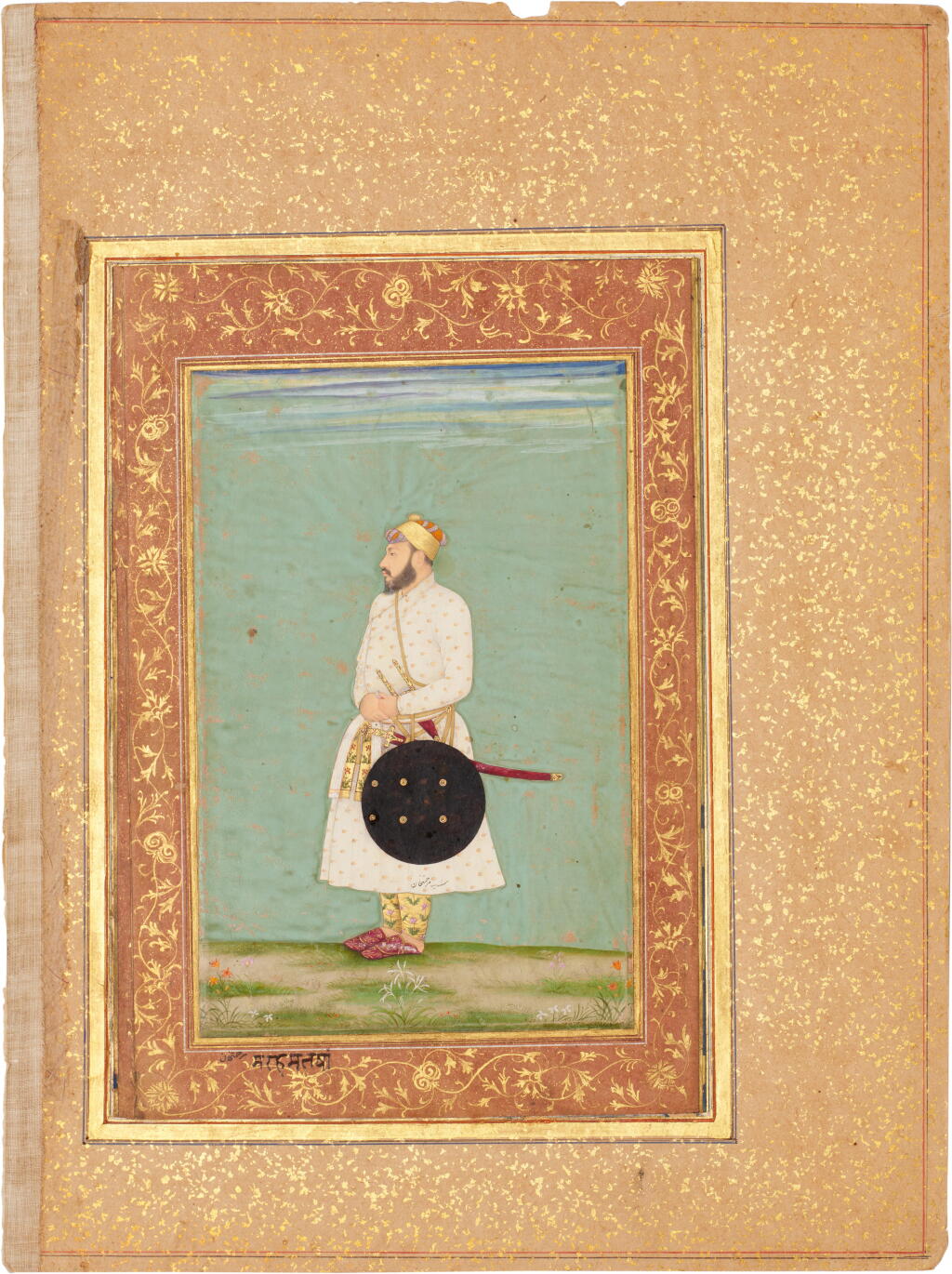
Marhamat Khan, attributed to Hashim, India, Mughal, circa 1630-31
Auction Closed
April 30, 03:48 PM GMT
Estimate
30,000 - 40,000 GBP
Lot Details
Description
gouache heightened with gold on paper, narrow gold inner border, dark red outer border decorated with gold scrolling vine, red and white rules, narrow gold outer border, gold speckled buff margins, black devanagari and nasta'liq inscriptions lower left edge of border, nasta'liq inscription to lower edge of jama
painting: 19 by 12cm.
leaf: 36 by 26.5cm.
Dazzling Visions, Mughal and Deccani Paintings from the Collection of Konrad and Eva Seitz, Museum Rietberg, Zurich, 30 November 2010 - 10 April 2011
J. Seyller and K. Seitz, Eva and Konrad Seitz Collection of Indian miniatures, Mughal & Deccani paintings, Zurich, 2010, p.57, no.12
The subject here is identified as Marhamat Khan on his jama and twice along the lower border.
Marhamat Khan was the brother of Nawab Jafar Khan and the son of Sadiq Khan Mir Bakhshi. On Shah Jahan’s accession in 1628 he was given mansab of 1,000 and was later made bakhshi (paymaster) of the ahadis. He is recorded as playing an important role in the capture of the fort of Dharur in the Deccan in 1631 and died prematurely between 1631 and 1632.
Marhamat Khan is seen in two other images. The first a ceremonial painting by ‘Abid dated 1629-30, possibly intended for the Padshanama, showing Marhamat Khan directly behind Shah Jahan holding a flywhisk (Lowry & Nemazee 1988, pl.54.) The second is a portrait painted approximately two decades later (see Sotheby’s New York, 22 March 1989, lot 68) showing a thinner Marhamat Khan.
Hashim was a leading Mughal portraitist, whose style was characterised by a crisp use of line and delicacy in the rendering of the facial features. The distinctive use of cloudband patterning on the jama is found in two other portraits by Hashim (Chester Beatty Library 7B.36, see Crill 2015, no.120) and an unidentified noble formerly in the Demotte Collection (Brown 1975, pl.XXVII). Seyller identifies the flame-like forms as a decorative device that provides a flickering energy.
You May Also Like