
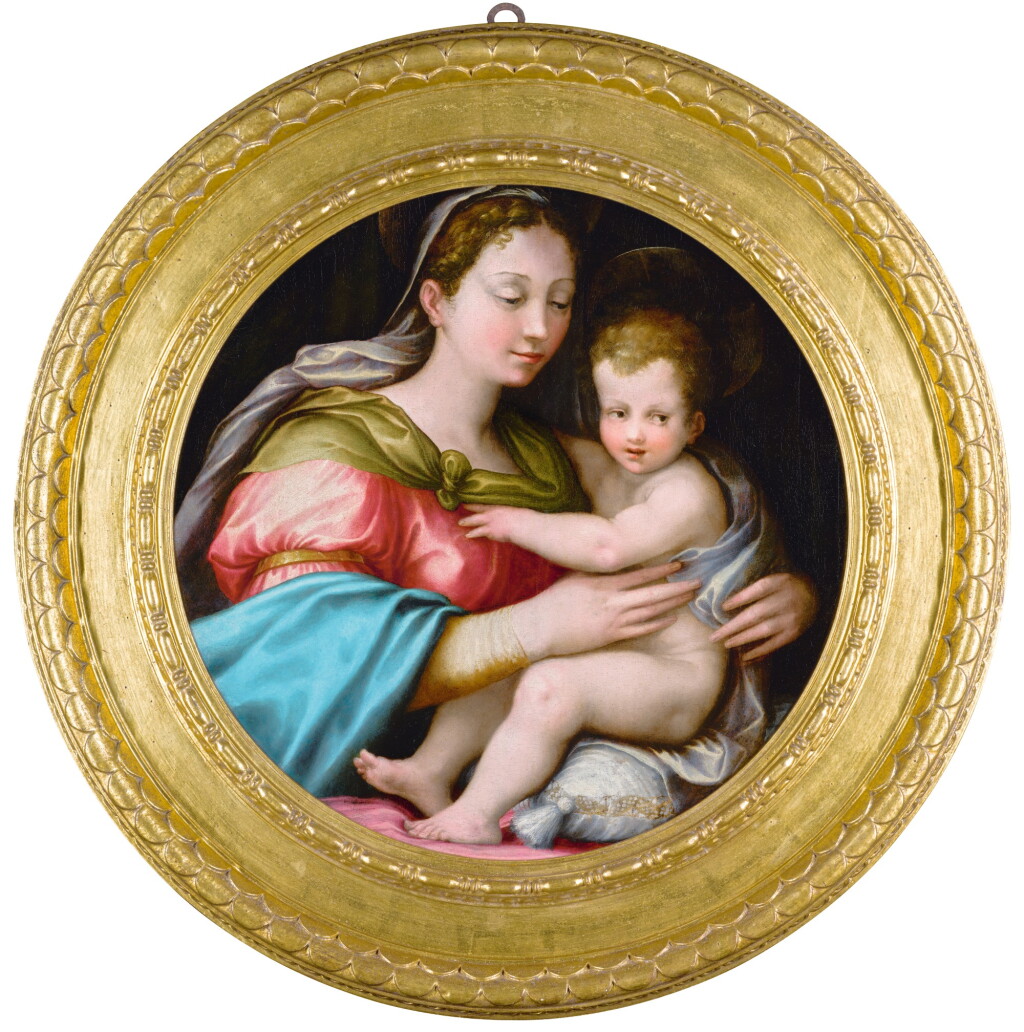
FRANCESCO DE' ROSSI, CALLED FRANCESCO SALVIATI | MADONNA AND CHILD
拍卖已结束
January 30, 12:05 AM GMT
估价
500,000 - 700,000 USD
拍品信息
描述
FRANCESCO DE' ROSSI, CALLED FRANCESCO SALVIATI
Florence 1510 - 1563 Rome
MADONNA AND CHILD
oil on panel, a tondo
24⅝ by 23⅞ in.; 62.5 by 60.5 cm.
This tondo is a newly discovered youthful work by Salviati, executed between his first Roman years and his Venetian period, circa 1538 – 41. Francesco de'Rossi, also known as Francesco Salviati or Cecchino, was one of the leading Mannerist fresco painters of the Florentine -Roman school. He was a close friend and contemporary of artist and biographer Giorgio Vasari, who described his style as la piu bella maniera (the most beautiful manner) among Florentine painters.
After studying with Andrea del Sarto, Salviati was called to Rome by Cardinal Giovanni Salviati, whose surname he adopted. He worked in northern Italy in the late 1530s, completing major commissions in Bologna and Venice, and absorbing the influence of Parmigianino’s paintings in Bologna. In addition to the impact of Parmigianino and Salviati’s Florentine predecessors, this early work shows Salviati’s interest in the antique and in the Roman Renaissance, as seen in the paintings of Michelangelo.
The shape of the Virgin’s face, her long, tapered fingers, and the folds of her drapery all compare closely with three other early works by Salviati. The face and drapery are most similar in his Annunciation for San Franesco a Ripa, Rome, painted in 1535. The elongated fingers and fluid drapery folds appear in his Adoration of the Shepherds, now in the Galleria degli Uffizi, another early work typically dated to the period between Rome and Venice. These mannerist hands suggest that Salviati saw some of Parimgianino’s works while traveling through Bologna. Perhaps the closest comparison in terms of drapery and facial features is with the altarpiece Salviati sent from Venice to Bologna for the Church of Santa Cristina della Fondazza, circa 1539-40 (fig. 1). The face of the Madonna in our painting and of Santa Cristina di Bolsena in the Bologna altarpiece are nearly identical.
We are grateful to Carlo Falciani for confirming the attribution to Salviati and suggesting an early date of circa 1538-41.