A
cross the centuries, the Chinese imperial court stood as the ultimate arbiter of artistic excellence, driving technical innovation and aesthetic refinement to heights unmatched anywhere in the world. From the bold, expressive brushwork of Yuan dynasty Jingdezhen to the sublime archaism and technical virtuosity of High Qing imperial workshops, the 13 masterpieces assembled here offer a sweeping window into the taste, devotion, and patronage of China’s most celebrated emperors.
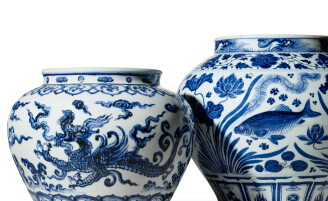
An exceptional and possibly unique large blue and white ‘makara dragon' jar, Ming dynasty, Yongle period
Embodying the free-spirited painterly imagination of the imperial kilns under the Yongle Emperor, this extraordinary jar is a triumph of early Ming ceramic art. Depicting a pair of kui (or xiangcao, “sweet grass”) dragons playfully pursuing each other across a ground of stylised crashing waves, the vessel synthesises Sino-Tibetan iconographic influences with Chinese porcelain mastery. The Yongle Emperor’s devout patronage of Tibetan Buddhism inspired a dramatic evolution in motif: here, the traditional Indian water guardian spirit—the makara—is reinterpreted through a distinctly Chinese aesthetic, featuring a classic dragon's snout, feathered wings, scaled body, and long trailing curlicue tails. The jar showcases the absolute pinnacle of underglaze-blue brushwork achieved at Jingdezhen. Nuanced three-dimensional washes of deep iron-laden cobalt pigment borrowed from Chinese ink painting capture the rhythmic motion of swirling foam and turbulent waters. The makara dragon design was rarely used on blue-and-white porcelain in the early Ming period, suggesting that this example was commissioned by the Imperial court for a special occasion. No other intact Yongle example of this design is recorded in public or private collections.
An important and exceptionally painted blue and white guan 'fish' jar, Yuan dynasty
This magnificent 14th-century guan jar featuring four lively fish darting amongst delicate water weeds and lotus sprays represents the crowning peak of blue-and-white porcelain design at Jingdezhen during the Yuan dynasty. Fish paintings were seen as the embodiment of the Daoist and literati ideals of spiritual freedom, as famously debated in the Daoist classic Zhuangzi.
“Look how the minnows come out and swim around so freely! That is the pleasure of fishes.”
— Zhuangzi
Other symbolic flourishes — a leaping carp, and blooming lotuses that mature, wilt and shrivel as the viewer turns the jar—are rendered with astonishing naturalism and vitality. Among the tallest and best painted of the Yuan fish jars, the master painter achieves remarkable depth and texture across the scales, fins, and flowing aquatic flora with tones of cobalt blue. The jar’s design was so admired that even a century after its production it was imitated by imperial potters working for the Xuande Emperor (1426-35), who rarely took Yuan designs as their models. Once in the esteemed collection of Sir Joseph Hotung, this particular jar was exhibited at the British Museum in 2012.
A fine and exceptionally rare blue-ground falangcai 'dragon' bowl, blue-enamel mark and period of Qianlong
A striking testament to the technical sophistication of the Qing imperial kilns, this rare and unusually large blue-ground vessel is a subtle synthesis of archaistic elegance and innovative palace taste. Bowls with a diameter of circa 16 cm were the largest listed bowl size in the palace archives. However, they were not functional wares for official occasions, but rather items of luxury, and thus showcased in the major palace halls of Qianqinggong (Palace of Heavenly Purity) and Yangxindian (Hall of Mental Cultivation). Featuring highly stylised kui dragons rather than the more commonly seen, naturalistic long species, the motif derives from late Shang bronzes and nods to the Qianlong Emperor’s appreciation of archaism, whilst also embracing baroque swirls more commonly associated with Kangxi prototypes. The formal dragon design on the present piece was apparently used for only one pair of bowls, as is characteristic of falangcai. Its counterpart is preserved in the Musée Guimet, Paris.
A fine and outstanding doucai and famille-rose ‘sanduo’ moonflask, seal mark and period of Qianlong
This resplendent moonflask testifies to the outstanding creativity of the Jingdezhen potters working under the Qianlong Emperor. The vessel brilliantly harmonises two celebrated decorative traditions: the delicate underglaze-blue outlines of doucai, characteristic of the Chenghua reign (1465-87), and the rich, opaque pastel enamels of famille-rose (fencai) which became available towards the end of the Kangxi reign (1662-1722). Historically rooted in early Ming forms, the moonflask’s classic silhouette is updated with archaistic bat handles and adorned with the auspicious sanduo (“three abundances”) motif — peaches for longevity, finger citrons for riches, and pomegranates for abundant progeny. Formerly in Hong Kong’s Tsui Museum of Art, this exceptional vessel appears to be one of only two known examples of this exact design. Its twin was formerly in the collection of the British Rail Pension Fund and was exhibited at the Tokyo National Museum in 1994.
A fine and very rare yellow-ground and underglaze-blue 'floral' jar and cover, mark and period of Yongzheng
Typifying the refined elegance of High Qing imperial ceramic production, this sumptuous jar is a superlative achievement under the guidance of legendary kiln superintendent Tang Ying (1682–1756). Perfectly potted with a voluptuous silhouette, the vessel pays homage to 15th-century early Ming designs, featuring scrolling floral blossoms and leaves rendered in vivid cobalt blue. Technically, it achieves a sublime synthesis: underglaze blue brushwork, deliberately painted with subtle “heaped and piled” shading to simulate Ming prototypes, is brilliantly juxtaposed against a captivating lemon-yellow enamel ground developed by Tang and his chemists from antimoniate oxide. While flat forms bearing this scheme are prized, upright vessels are extraordinarily rare, let alone one that retains its cover. Preserved in remarkable condition from an old Japanese collection, this jar is a quintessential masterpiece of Yongzheng court innovation, harmonizing past tradition with groundbreaking technical refinement.
A magnificent and extremely rare yangcai blue-ground 'lotus’ ruyi-handled vase, seal mark and period of Qianlong
Formerly in the Fonthill House collection of the eminent Victorian collector Alfred Morrison, this vase attests to the Qianlong Emperor’s insatiable quest for painterly ingenuity. Produced at Jingdezhen under the direction of its legendary supervisor Tang Ying, the vessel is cloaked in a vibrant, jewel-like deep blue ground—an extraordinarily rare color choice within the yangcai (“foreign colors”) canon. Painted with an ornate scroll of stylized lotus blooms, this pear-shaped vase is framed by gracefully sculpted handles in the form of ruyi sceptres, entwined with crimson ribbons suspending wan symbols, which were introduced into China with the spread of Buddhism. Wan, a homophone for the Chinese for “ten thousand” or “infinity”, is combined with the red ribbon design (shoudai) to wish a symbolic “ten thousand longevities without boundary” (wanshou wujiang). The composition subtly integrates Western Baroque artistic conventions, with shaded pearl-like roundels and mock-sgraffiato ground that bestow a three-dimensional tactility reminiscent of the finest embroidered silk brocade. Blue-ground yangcai vases were produced on imperial order during a short period, primarily between 1748-1750, with only three pairs of vases recorded in the imperial accounts.
A fine and very rare blue and white 'sanskrit' inscribed bell, seal mark and period of Qianlong
Distinguished by its delicately “penciled” underglaze-blue brushwork, this exquisite ritual bell exemplifies the consummate skill of the imperial kilns under the Qianlong Emperor. Porcelain bells are inherently rare, and examples executed in blue underglaze are exceptionally scarce. Taking inspiration from early Ming prototypes, the bell is surmounted by a sculpted double-headed beast handle, around whose base the four-character Qianlong seal mark is split and positioned. Bands of finely rendered Sanskrit characters, conveying sacred Buddhist mantras, alternate with undulating leafy lotus scrolls. The meticulous line work echoes that seen on a select group of imperial Qianlong stem bowls. Made for court ritual performance or devotional display, this piece reflects both the Qianlong Emperor’s devout patronage of Tibetan Buddhism and Jingdezhen’s unyielding ceramic innovation.
A fine and exceedingly rare blue and white 'lotus’ mantouxin bowl, mark and period of Xuande
Emblematic of refined Xuande aesthetic, this rare mantouxin (“steamed bun centre”) bowl demonstrates the superlative potted sophistication of early 15th-century imperial porcelain. It is characterised by its distinctive domed mound interior base—a tactile homage to Middle Eastern Mamluk metalwork that arrived in China via maritime trading routes in the early Ming dynasty. Believed to be the companion to an identical mantouxin bowl from the collection of Raymond F.A. Riesco sold in 2013, it is delicately rendered in contrasting tones of luminous cobalt blue, exhibiting the prized “heaping and piling” effect characteristic of imported Persian smalt, and intricately painted with an all-over scrolling lotus pattern on the interior, with a “cash diaper” band at the rim. The unusual design is completed on its exterior, with decorative bands of delicate lotus scroll and pendant trefoils. Similar Xuande mark and period examples can be found in the Palace Museum in Taipei, and the Haags Gemeentemuseum in The Hague.
Originating from an old Hong Kong family collection, this bowl and a selection of notable Ming and Qing ceramics in the sale (see lots 6001–6013 and 6080–6086) were assembled from the 1920s by a prominent East Asian industrialist. His refined taste and lifelong devotion to connoisseurship—spanning painting, calligraphy, scholar’s objects, and ceramics—quietly graced his family’s Hong Kong residence for over half a century.
A fine and rare miniature blue and white 'lotus’ garlic-mouth vase, mark and period of Yongzheng
With monumental poise despite its intimate scale, this rare miniature santouping vase embodies Qing dynasty imperial refinement. Modelled with a bulbous garlic-head mouth tapering into a slender, graceful neck and rounded body, the vessel is masterfully painted in rich cobalt blue tones with an elegant yet complex star-shaped design of eight ruyi-shaped lotus petals, reminiscent of Islamic-style decorations on Yongle blue and white porcelains. Drawing upon ancient bronze prototype shapes revived during the High Qing period, the form reflects the court's archaistic tastes, with the Yongzheng Emperor known to have sent examples of his favourite ancient ceramic styles to the imperial Jingdezhen kilns for reference. Only one other closely related example has been published, and is in the collection of the Palace Museum in Beijing.
A fine and rare Ru-imitation celadon-glazed narcissus bowl, seal mark and period of Yongzheng
This exceedingly rare Ru-imitation narcissus bowl encapsulates the Qing court's profound reverence for Northern Song classicism. Crafted in homage to legendary 12th-century Ru wares — the rarest of all Song imperial ceramics — this elegant vessel features rounded tapering sides resting on carved cloud-scroll feet. It is enveloped in an unctuous, pale bluish-green celadon glaze, meticulously formulated at the imperial kilns to recreate the semi-translucent, "sky-after-rain" hue praised by emperors. Created during the Yongzheng reign, when archaism reached its zenith, this bowl evidences Qing technical virtuosity and refined scholar-emperor aesthetic taste. Qing dynasty imitations such as the present piece are incredibly rare, with only two other known examples: one in the Taipei Palace Museum (bearing a Qianlong imperial poem praising Ru ware and most likely produced under the supervision of Tang Ying) and the other in the Beijing Palace Museum.
An exceptional imperial yellow and russet jade boulder, Qing dynasty, Qianlong period
A breathtaking miniature mountain, painstakingly carved from the dramatic hollows of a yellow and russet jade boulder standing 26 cm high, is a startling vision of fantasy and drama. A fisherman moors his boat at the mouth of a secluded grotto—a reference to Peach Blossom Spring, Tao Yuanming’s tale of a fisherman who discovers an earthly paradise hidden beyond a cave, only for the entrance to disappear when he later tries to find it again. Crafted for the private enjoyment of a scholar’s studio or private chamber during the height of the Qianlong reign, the carver exhibits his technical brilliance through dramatic spatial depth and sensitive incorporation of the jade’s natural russet skin. As the largest recorded yellow jade boulder of its kind, its historical significance is further heightened by a distinguished provenance, originating from the Qing imperial court before entering the famed collection of Parisian dealer and connoisseur Madame Florine Langweil (1861–1958) in the early 20th century.
An important and exceptional Junyao flowerpot, early Ming dynasty
Exemplifying sublime imperial taste, this rare mallow-form Junyao flowerpot marks the pinnacle of official monochrome ceramics. Covered in an ethereal, luminous sky-blue glaze, the vessel is delicately molded with lobed fluting that gracefully fans outwards. Distinct from export wares, numbered Jun vessels were created exclusively for the inner sanctum of the imperial court — appearing in Ming court scroll paintings placed before the Xuande Emperor, and later treasured within the private residences of the Forbidden City by the Qing emperors. Incised prior to firing with the numeral wu (five) on its base, most likely to designate size, only one other comparable wu-marked vessel of this form is recorded, now housed in the National Palace Museum, Taipei. The base of this pot displays grinded ‘T’ shaped marks, suggesting it had once been displayed in the Qing imperial palaces, and is accompanied by an exquisite 18th-century white jade stand. It was formerly owned by the Hong Kong shipping magnate T.Y. Chao.
An extremely rare and large relief-carved turquoise-glazed 'bajixiang' incense burner, seal mark and period of Qianlong
An innovative tour de force, this majestic censer captures the Qianlong Emperor’s penchant for archaic forms fused with ceramic virtuosity. Modelled after an ancient bronze ding, the monumental vessel is carved in deep relief with the bajixiang (Eight Buddhist Emblems) amidst dense lotus scrolls. An unusually prominent relief-carved imperial reign mark along the rim distinguishes this vessel as an important imperial commission, likely intended for an altar within one of the imperial palaces or temples. Its crowning achievement lies in its vibrant pastel turquoise glaze—a revolutionary 18th-century formula mixing pastel glazes with white enamel over biscuit porcelain to mimic the smooth, matte tactile beauty of natural turquoise gemstones. Formerly owned by the British aristocrat and Hong Kong equestrian figure Grace Mary "Billie" Liddell before being gifted in the 1950s to Dr Leon Seng, this magnificent incense burner survived as a cherished family heirloom.